A scanner came back clean
Scanners need package manifests, a supported language and version history. Old systems often lack at least one, so a short, clean report can mean the tool had little to read.
A 30-day code audit of your legacy application before you rewrite it. We read the code, the database and the running system, not just the files. Read-only access, fixed scope, and six answers in writing you keep.
Read-only access, and nothing more.
Can we keep this system, change it, or replace it?
Which business rules exist only in the database?
Who can still change each part of the system?
What could the audit not determine?
Business rules, integrations, operator knowledge, support clocks, and unknown consumers determine the safest path. We map those constraints before recommending retention, integration, incremental replacement, or retirement.
Scanners need package manifests, a supported language and version history. Old systems often lack at least one, so a short, clean report can mean the tool had little to read.
Calculations and edge cases sit in stored procedures, triggers and views, written over years by people who have since moved on. A rewrite quote made from the outside can't see them.
Every change waits for the one engineer who still understands it. Version history shows which modules only one person has touched, and whether they still work there.
Every engagement ends with a traceable estate view, a prioritized sequence, and explicit uncertainties your team can resolve.
What works, what is fragile, and what nobody has written down.
Practical options with trade-offs, including doing less than you planned or nothing at all.
What fits your stack and team, and what would be hype for your case.
Where handoffs, approvals and ownership slow the work down.
If you want it: a path to a modern system without a big-bang cutover.
A phased roadmap with durations, dependencies and decision points.
The exception path comes before the happy path. Recommendations stay reversible until the evidence supports commitment.
We agree the estate, the people, which code, repositories and databases we read, and what you will receive.
NDA signed and read-only access granted. Then we read: data lineage traced, workflows identified, dependencies and consumers mapped.
Engineers verify the findings with your team. Retain, integrate, wrap, replace, or retire: practical paths compared with their tooling.
Architecture, workflows, recommendations, risks, and a timeline with durations, documented and walked through with your decision makers.
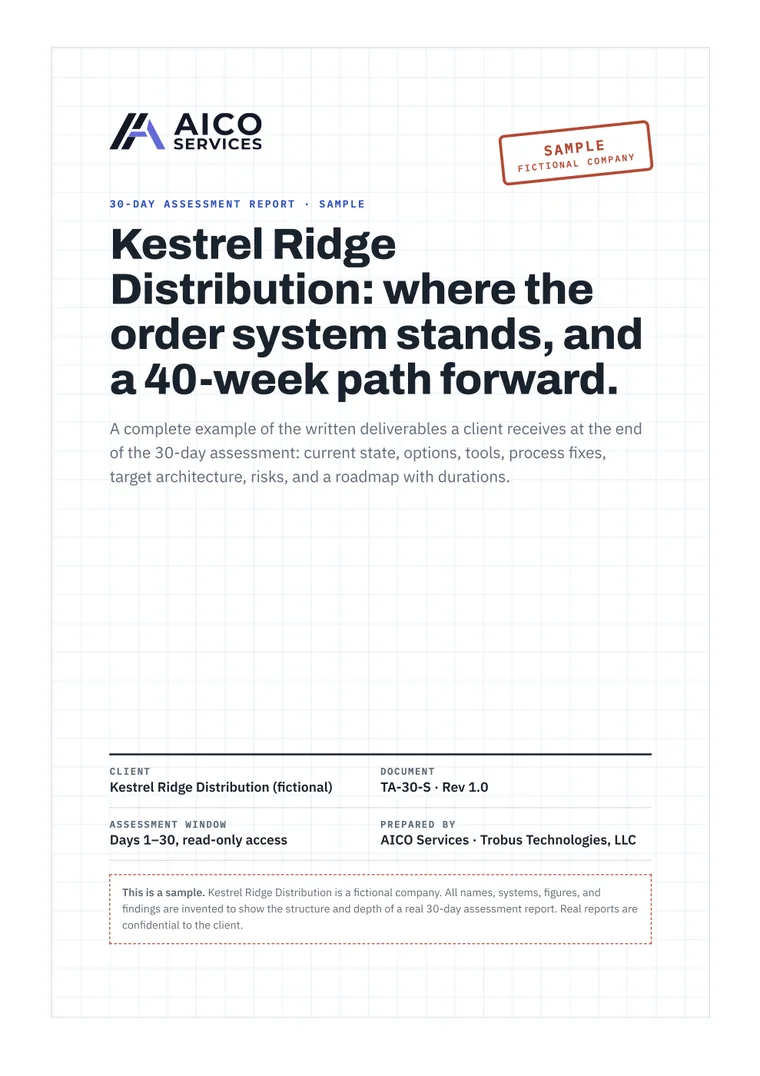
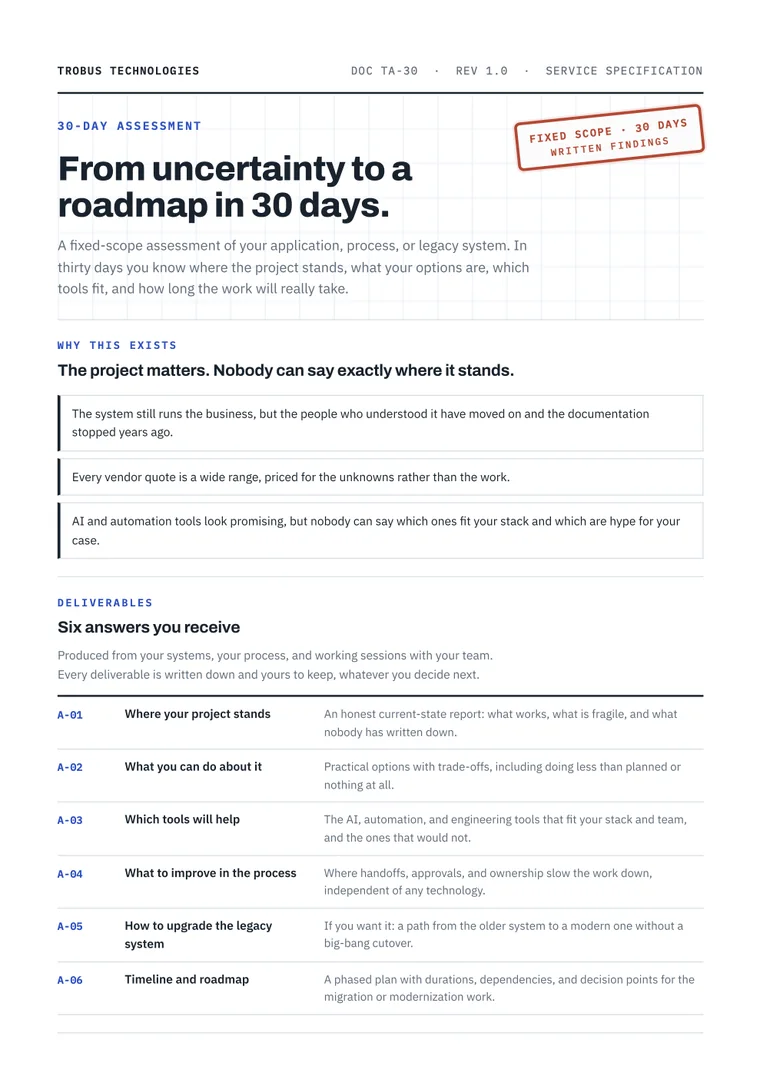
We email you the 2-page specification and two sample reports from a modernization assessment, one for executives and one for engineers: findings, the recommended path per application, risks, support status and effort.
A Maryland-based engineering company. AICO Services is how we package our AI automation, modernization, and assessment work. Our engineers have delivered for organizations including these.


Organizations represented in the broader Trobus Technologies delivery history. Engagement scope and team role vary; reference details are shared where authorized.
Verified credentials maintained by Trobus Technologies, LLC
Bring the estate, the deadline, and the uncertainty. We’ll explain what can be learned safely before a modernization program begins. We will tell you when not to modernize it, and the assessment says so in writing.
Start a 30-day assessment