Typing errors create downstream cleanup
A transposed digit in an invoice total or a policy number is not caught at entry. It surfaces weeks later as a reconciliation problem, a chargeback, or a customer complaint.
We capture information from forms, documents, inboxes, and partner systems, validate it, and move it into the right business tools with human review only where judgment is needed.
Invoices, applications, orders, and forms arrive as PDFs, photos, and emails. Someone reads each one and types it into software that already knows most of the answer. We extract the fields, check them against your rules, and send only the uncertain cases to a person.
Fields above the confidence threshold post automatically. The rest go to a reviewer.
supplier_idSUP-014299% Postinvoice_numberINV-2048898% Postpo_matchPO-7731 · open97% Posttotal_amount4860.0096% Postdue_date2026-10-0294% Posttax_codeAmbiguous61% ReviewEvery row is a step your team handles today. The right column is what the workflow does after the build, with people kept where judgment is needed.
Open, scan, find the fields
Extracted with a confidence score
Typed into the system
Posted directly when confident
Eyeball against a PO
Matched and tolerance-checked by rule
Noticed occasionally
Blocked before posting
Whoever remembers
Timestamp, result, reviewer
A transposed digit in an invoice total or a policy number is not caught at entry. It surfaces weeks later as a reconciliation problem, a chargeback, or a customer complaint.
Throughput is fixed by how many people are typing. A busy season, a new contract, or one person on leave turns a manageable queue into a backlog.
Documents are processed from a shared inbox with no log of who handled what. When a customer asks whether something was received, nobody can answer with confidence.
Around 1,400 supplier invoices a month arrived as PDFs and photos. Two accounts-payable staff keyed each one into the accounting system and matched it to a purchase order by hand. Month end regularly slipped.
Extraction produced structured fields with confidence scores. Purchase-order matching, duplicate checks, and tolerance rules decided what posted automatically. Anything uncertain landed in one review screen.
Most invoices posted without a human touch
Duplicate and out-of-tolerance invoices stopped before posting
Month-end close no longer waited on data entry
The engagement is sized around one useful operational outcome. Your team receives the implementation, operating context, and visibility needed to own it.
Documents, emails, forms, fields, variations, and edge cases mapped against their destination systems.
Confidence thresholds, business rules, duplicate controls, and review queues designed around operational risk.
A monitored pipeline that extracts, validates, routes, and records each transaction.
Each stage has a clear decision and output, so the project remains connected to the business problem.
We collect real samples of each document type, note the variations, and map each field to where it must land.
Extraction produces structured fields with confidence scores. Business rules, duplicate checks, and thresholds decide what is posted and what is reviewed.
The share of documents posted without human touch, review turnaround, and error rate are reported weekly.
We connect to what is in place through APIs, exports, and databases. Nothing here requires a platform change, and tools not listed are usually reachable too.
Hundreds of similar documents a month
Fields map to known destinations in a system
Rules for what is acceptable can be written down
Errors are costly to find later
Fewer than a few dozen documents a month
Each document needs interpretation, not extraction
The destination system has no way to accept data
The 30-day assessment says whichThree questions we hear most often about this service. The rest is answered in the assessment.
Accuracy depends on the document type. The design assumes imperfection: fields below a threshold are reviewed by a person, and the threshold is tuned on your real samples.
Directly into the system you already use through its API or import path. We do not introduce a new place for data to live.
They are routed to review by default. As patterns repeat, rules are extended so the straight-through rate rises over time.
Most documents post to the target system with no human touch.
Low-confidence fields are reviewed in one screen, not rekeyed from scratch.
Duplicates and out-of-policy values are stopped before they enter your books.
Every document has a processing record with a timestamp and a reviewer.
Thirty days inside the process and the tools around it. You finish knowing what to automate, with what, in which order, and how long it will take.
Start a 30-day assessment Scope: Fixed · Access: Read-only · Output: Written findings you keepHow the work really flows today: volumes, handoffs, waits, error rates, and the automations that already exist.
Which steps to automate, which need an AI step, which should stay human, and which to leave alone.
n8n, Zapier, Make, agents, or custom code: what fits your stack, team, and budget, and what would be hype.
Rules, ownership, and data fixes that should come before or alongside any automation.
If older software is in the way: how to connect to it, wrap it, or upgrade it so automation is possible.
A sequenced build plan with durations, costs to expect, and the measures that prove it worked.
We walk you through our in-house analysis system, which scans your code, repositories, and databases, and agree exactly what the assessment will cover and what you will receive.
Once you are ready to proceed, we sign an NDA and you grant read-only access to the necessary repositories and databases. Then our system runs.
Senior engineers verify what the system found in working sessions with your team, and capture what is not written down anywhere.
You receive the written findings and we walk the decision makers through them.
A Maryland-based engineering company. AICO Services is how we package our AI automation, modernization, and assessment work. Our engineers have delivered for organizations including these.










Organizations represented in the broader Trobus Technologies delivery history. Engagement scope and team role vary; reference details are shared where authorized.
Verified credentials maintained by Trobus Technologies, LLC





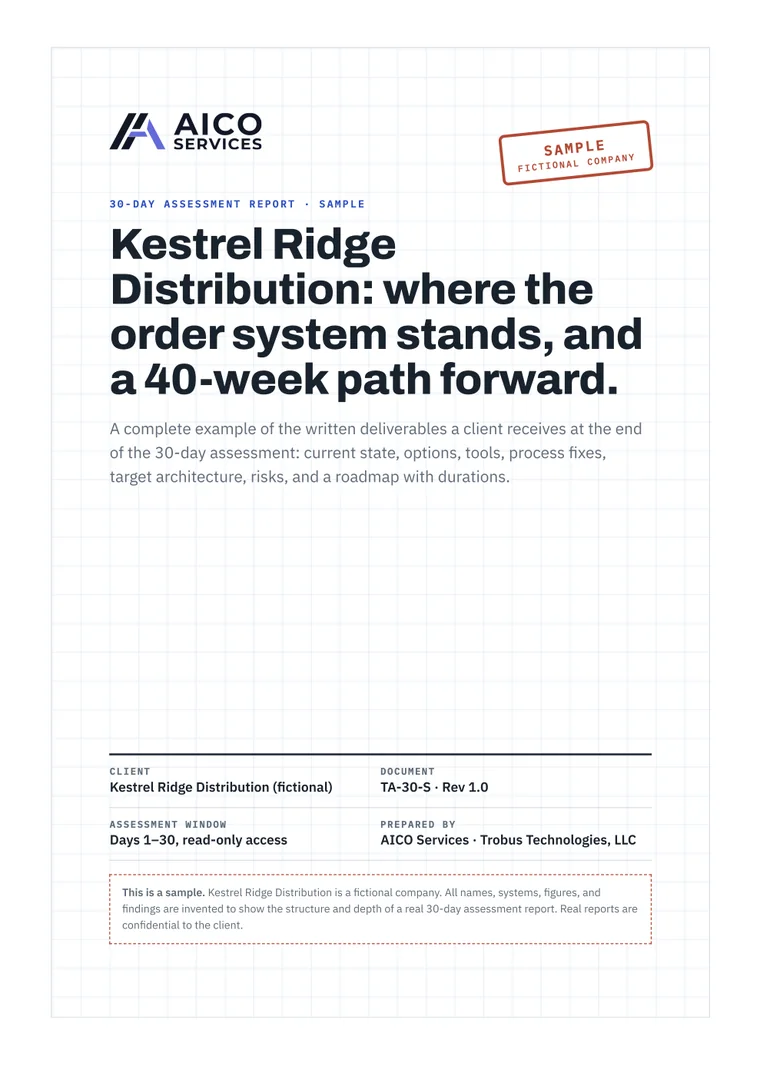
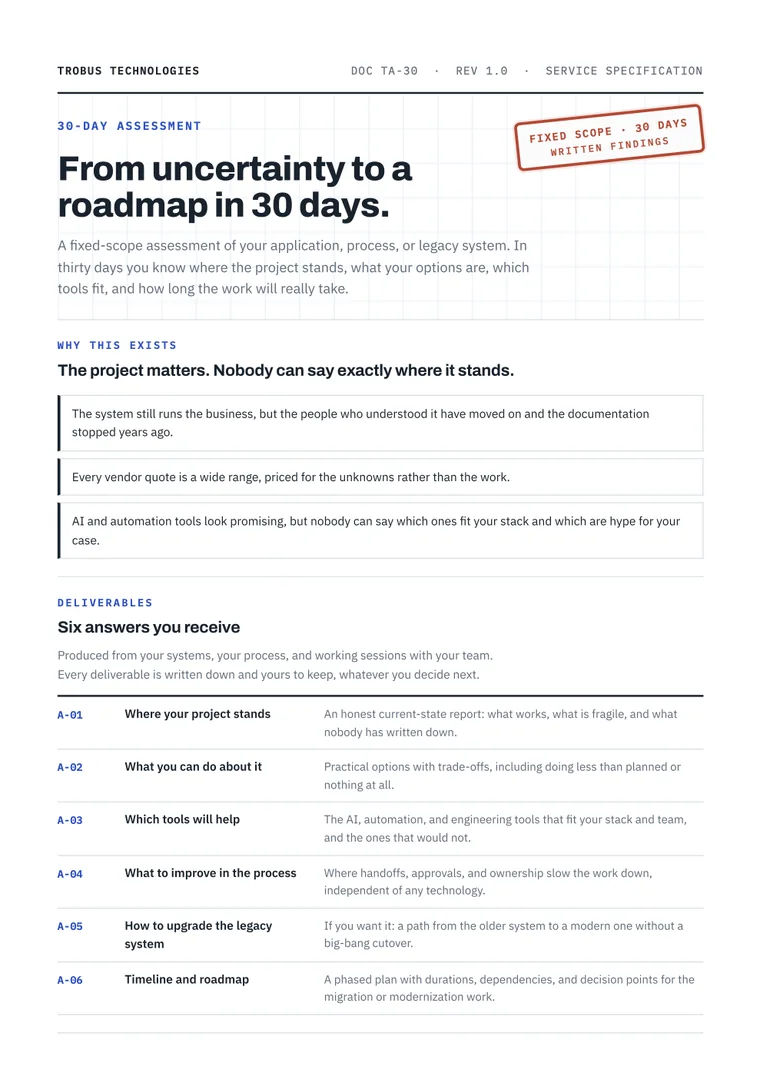
We email you the 2-page specification and a 13-page sample report written for a fictional company: findings, options compared, recommended tools, target architecture, risks, and a 40-week roadmap.
The 30-day assessment tells you whether it is a good candidate, which tools fit, and how long the build will take. We will tell you when not to automate it, and the assessment says so in writing.