Rules in a stored procedure
Calculations and edge cases live in the code, not in any document.
Code audit · 30 days · read-only
Before anyone proposes a build, we read your code, repositories and databases. In thirty days you get six answers in writing, and a roadmap you can act on, with us or with anyone else.
Scope: fixed · Access: read-only · Output: written findings you keep
Older systems hold business rules nobody wrote down. They tend to surface after the contract is signed.
Calculations and edge cases live in the code, not in any document.
Every change waits for the one person who still understands it.
It only shows up when something breaks.
Common patterns, shown for illustration.
Systems we read VB6 · PowerBuilder · Oracle Forms · IBM i / RPG · .NET / WCF
Everything a rewrite would have to reproduce, read by our engineers with read-only access.
Forms, modules, stored procedures and the calculations hidden in them.
Schemas, the tables each screen and job touches, and where data comes from and goes.
Interfaces, file drops, batch jobs and the systems that depend on them.
Platforms, libraries and runtimes, and which of them are near or past end of support.
Who can reach what, how credentials are held, and the risks that come with the age of the system.
How a change gets from a developer to production today, and what would break first.
What you receive on day 30. You keep every document, whatever you decide next.
What works, what is fragile, and what nobody has written down.
Practical options with trade-offs, including doing less than you planned or nothing at all.
What fits your stack and team, and what would be hype for your case.
Where handoffs, approvals and ownership slow the work down.
If you want it: a path to a modern system without a big-bang cutover.
A phased roadmap with durations, dependencies and decision points.
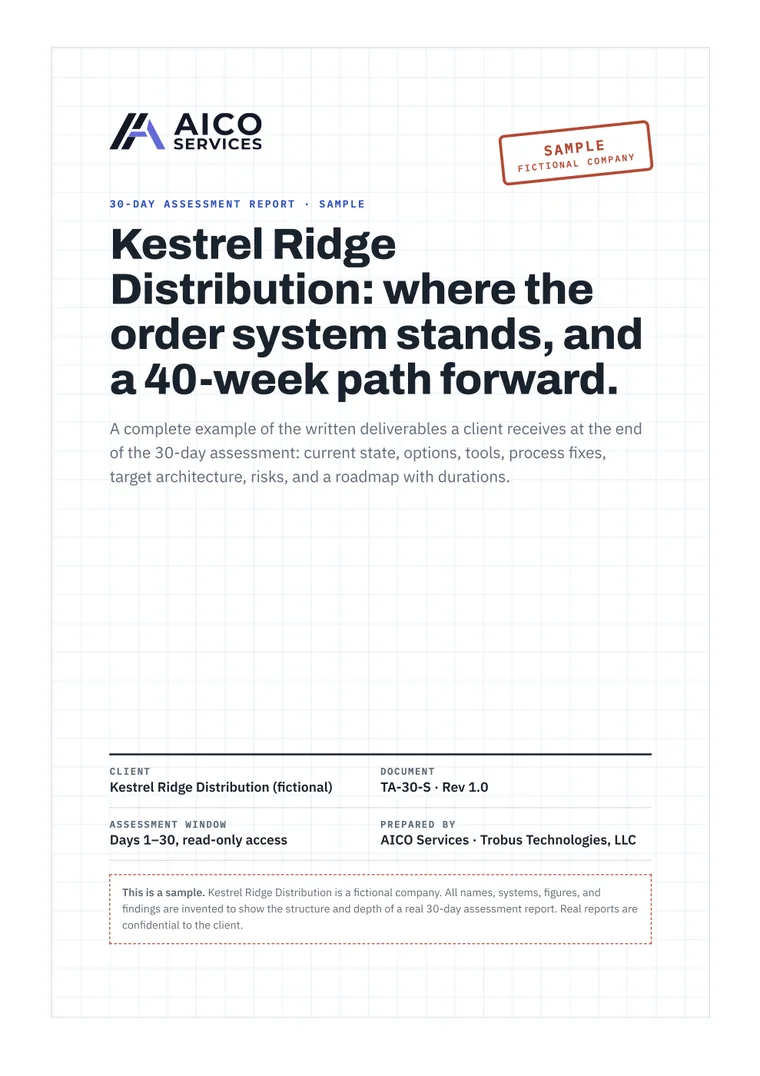
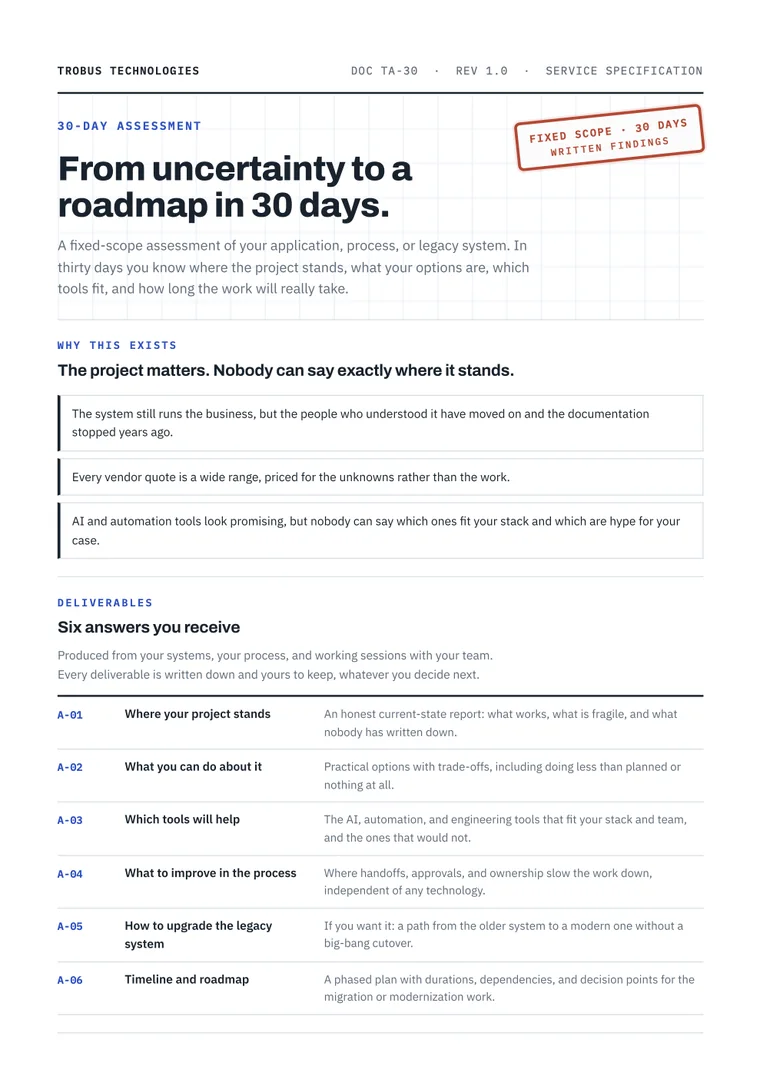
We email you the 2-page specification and two sample reports from a modernization assessment, one for executives and one for engineers: findings, the recommended path per application, risks, support status and effort.
How the 30 days run. You decide go or no-go in week 1, before anyone has access.
We agree exactly what the audit covers and what you receive. A go or no-go before any access is given.
We sign an NDA, you grant read-only access, and we trace data across code and databases.
Working sessions with your team confirm or correct what we found, and capture what is written down nowhere.
You receive the written findings, and we walk your decision makers through them.
The audit is a decision tool, not the first phase of a sale.
Agreed in week 1, in writing, before any access.
One fixed price in a written quote.
An NDA before anything is shared.
As a separate project. The report stands on its own.
If yours is not here, ask it on the call.
Engineers who did not write the system read its code, databases and integrations, and report in writing what is there: the business rules, the risks, and what it would take to change or replace it.
No. We work with read-only access to the repositories and databases agreed in week 1, after an NDA is signed. Nothing we do changes your systems.
Six written answers: where the system stands, your options, the tools that help, process fixes, an upgrade path if you want one, and a phased roadmap with durations. Your decision makers get a readout, and you keep every document.
It depends on the scope agreed in week 1: which applications, code and databases the audit covers. You get one fixed price in a written quote before we start.
No. The options include doing less than you planned, or nothing at all. If you want help with the work afterwards, it is a separate project, and the report stands on its own with any team.
A kickoff in week 1, someone to grant access in week 2, working sessions with the people who know the system in week 3, and the readout in week 4.
A short call: you tell us about the system, and we tell you whether the 30-day audit fits. Reply within one business day.
Book a call